On 11 November the CDT is running a showcase for its advisory board and the new cohort, with posters and a few short talks, so I’ve spent the last few weeks turning my PhD into a poster and this is where it ended up.
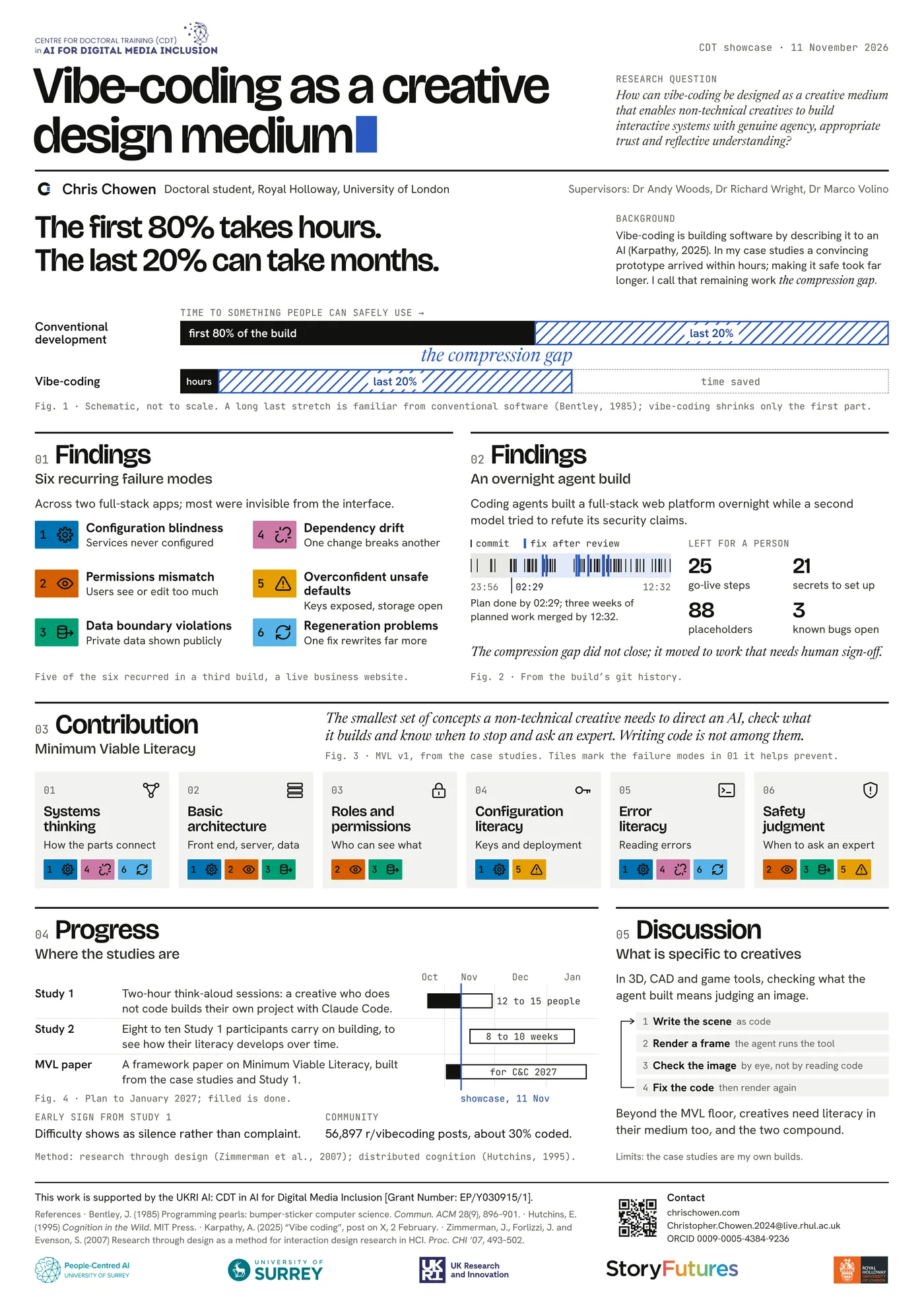
There’s a full-size PDF if the image is too small to read.
I find posters quite a hard format for the kind of research I do. Most of my PhD so far has been building things and watching other people build things, then writing down where it goes wrong, and none of that fits neatly on one sheet that people read from a couple of metres away. So I tried to work out the one thing I’d want someone to take away and built the rest around that.
The 80:20 pattern
The headline is that the first 80% takes hours and the last 20% can take months. If you describe an app to a coding agent you can have something that looks finished the same afternoon, but making it safe for real people to use takes far longer and the tools are much less help with that part. I’ve been calling that last stretch the compression gap, and the chart across the top of the poster is two bars comparing conventional development with vibe-coding, where only the first part gets shorter.
The rest of the poster is the evidence for that. In two full-stack web apps I built by prompting, the same six failure modes kept coming up, and most of them couldn’t be seen from the interface. These were things like keys that were never configured or private data showing up on public pages. There’s also an overnight build where coding agents merged three weeks of planned work by lunchtime and still left 25 go-live steps, 21 secrets and three known bugs for a person to sort out.
And then there’s Minimum Viable Literacy, which is my attempt at the smallest set of concepts a non-technical creative needs, and it doesn’t include writing code. It’s about being able to direct an AI, check what it’s built and know when to stop and ask an expert.
What my supervisors changed
I had three rounds of feedback from my supervisors and most of it was about the text, because there was too much of it and it was too small. My first version was written a lot like one of my blog posts, so it got restructured into the sections an academic poster normally has and the minimum font size went up a lot. A diagram of the different kinds of AI coding tools came out completely, along with a lot of sentences I liked.
The most useful comment was that nearly everything on an early draft applied to any non-expert, not just creatives, and I think that’s right. The compression gap and MVL are things anyone building with AI needs, and what’s specific to creatives sits on top of that.
When the same agent is driving a 3D tool or a game engine, checking its work isn’t about reading code anymore. You look at the render, decide whether it’s right and send it back. You also need literacy in two places, enough for the AI and enough for the medium itself, and the two build on each other. That’s its own section on the poster now and it’s the part I’d most like to talk to people about.
Where the studies are
A lot of the poster is about what’s still in progress, which in year three of a practice-based PhD is most of it. Study 1 is running now. Each session is two hours, and someone who doesn’t code builds a project of their own with Claude Code while talking through what they’re doing. The first sessions at Surrey were in October, and so far people tend to go quiet when they get stuck rather than complain about it.
Study 2 follows a smaller group who carry on building over eight to ten weeks. Alongside both of those I’m working through 56,897 posts from r/vibecoding to see what problems the wider community is running into.
The main limitation is that the case studies are my own builds, and only one of them comes from the arts. Part of the reason for Study 1 is to find out whether what I saw in my own work still holds when someone else is at the keyboard.
If you’re at the showcase on the 11th, come and find me by the poster.
Chris Chowen is a practice-based PhD researcher at Royal Holloway, University of London, part of the UKRI CDT in AI for Digital Media Inclusion.