Too many ideas, not enough skill
I’ve always had way more ideas than I can actually build. I’ll get excited about something, start working on it, hit some technical problem I can’t solve, and then it just sits there. I didn’t have the money to hire developers, and I’m too stubborn to give up control of a project, so most things ended up abandoned.
On the plus side, failing at loads of different things has made me a decent generalist. I know a bit of everything. Just not always enough to finish what I started.
The first thing I built with GPT-4
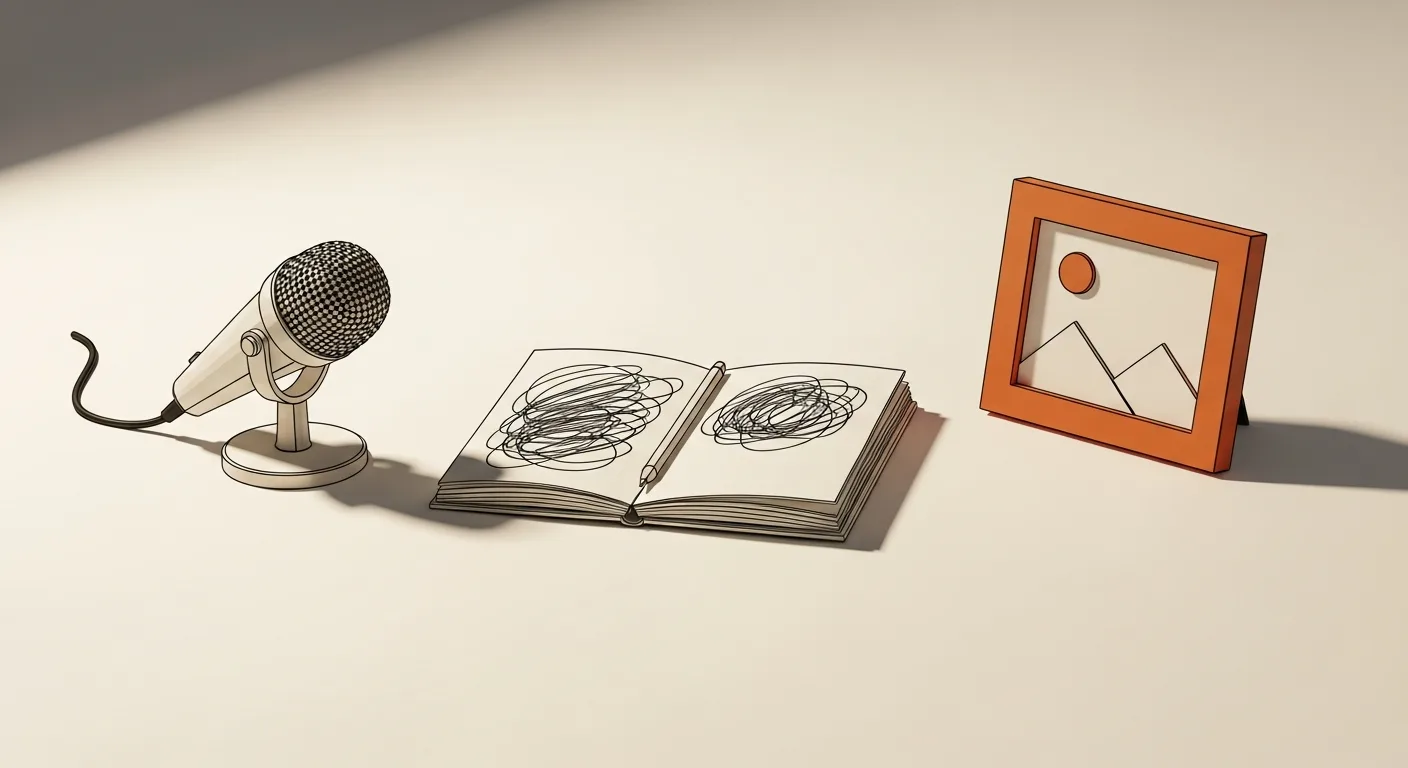
The first project I genuinely built with GPT-4 was a live poetry pipeline. Whisper transcribed the audio as a poet performed, GPT-4 (the API was about a week old) parsed the subtext and turned it into a Stable Diffusion image prompt, and the diffusion model produced an image as the poet finished each piece. Words to images, in roughly real time, in the room.
Today that’s a one-evening project for an experienced developer. A few well-known APIs glued together. In early 2023 it was the kind of thing I would not have tried, because the glue layer required exactly the kind of code I always got stuck on. With GPT-4 I had a working version in three days, and most of those three days were me hand-fixing the bits the model got wrong, not writing the bits from scratch.
I remember the moment I realised this was different. I’d asked Claude (no, GPT-4 at the time) to explain a particular Python error like I was twelve, because I genuinely could not work out what it was telling me. The reply was patient, accurate, and produced a fix that worked first time. That had never happened. Stack Overflow doesn’t write you a fix. Documentation doesn’t pat you on the back. It wasn’t better technically than the references I’d been using; it was kinder, and at the speed I work that turns out to matter.
What changed in the workflow
CSS that used to take me ages of googling was done in minutes. I started feeding it API documentation it shouldn’t have known about (2021 cut-off and all that) and the model would just absorb it on the spot. That’s how I ended up building chatbots wired to tools GPT-4 had never seen before.
When I hit an error I’d paste the whole traceback in. It would tell me what was wrong. That alone has saved me, conservatively, hundreds of hours of dignity-shredding searching.
The things I actually finished
Projects that would normally take me weeks were getting done in a single evening. The FuseBox chatbot. Some Google Docs / Sheets extensions for surfacing patterns in workshop feedback. A GPT-powered game in Unity. A Python tool that turns kids’ drawings into Regency-era paintings. The list keeps going. The thing they have in common is that none of them would have shipped a year earlier. Not because the ideas weren’t good, but because the gap between I want this and I have this was wide enough to lose me on the way.
The biggest example, the one I’m still iterating on, is the AR business card. It started in 2019 as a green-screen hologram on a printed card and has been quietly improving every couple of years. The version live today wouldn’t exist without GPT-4 (and later Claude) compressing the experimental phases. The card is now a conversation rather than a video, with a knowledge base of this site, and the plumbing to make it a standalone product if I ever decide to ship it that way. The idea has lived in my head since before I had any business owning it.
The weird bit
If GPT-4 can do most of what I’ve spent years learning to do, what does that make me?
I used to watch artists complaining about AI image generators and thought I got it. Now it’s happening to my thing and yeah, I actually get it now. The argument I used to find slightly sentimental (the craft matters, the time matters, the years of practice matter) suddenly has my own years in it.
I don’t have a clean answer. I think someone still needs to have the ideas and know which ones are worth building, and I think the part of the work that doesn’t compress (the question of what to make, why, for whom, with what consequence) is exactly where my time is now best spent. Whether that’s enough to justify a career I’m still working out.
For now I’m using it as much as I can. I’ve shipped more stuff in the past two months than in the previous two years. I’ll take that, and write about what it teaches me later, when I’ve watched a few more projects survive long enough to fail in interesting ways.