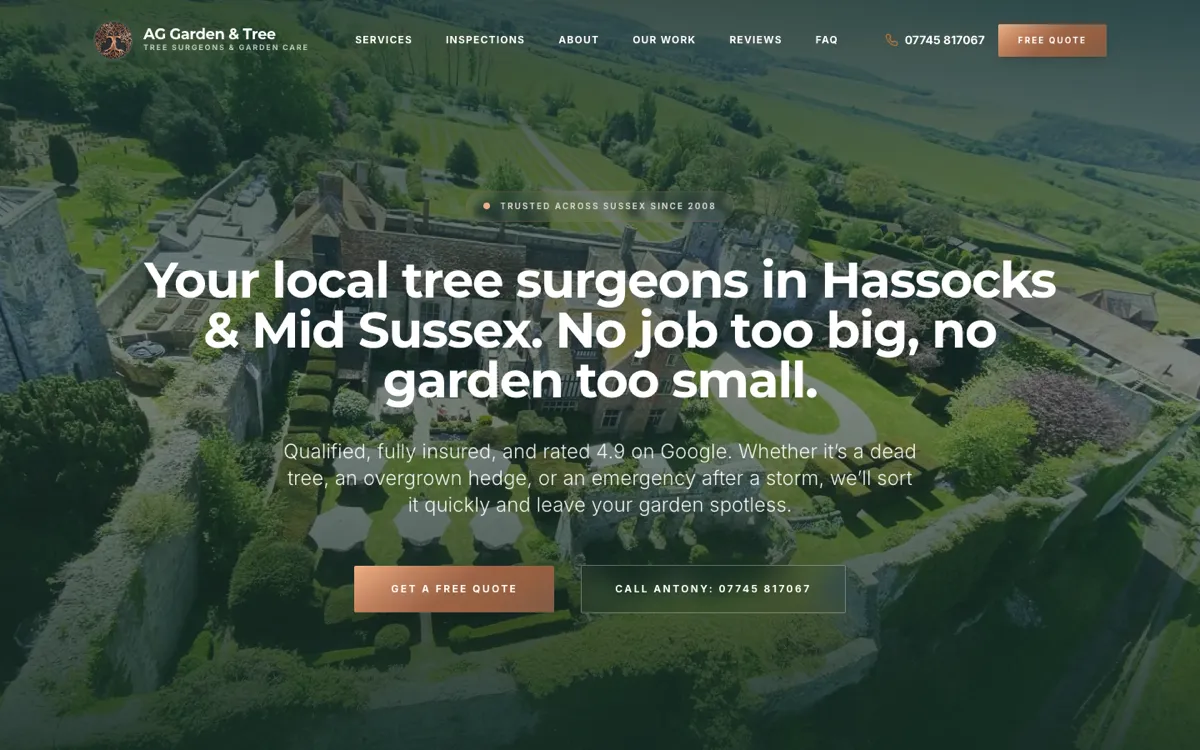
AG Garden & Tree is Antony Geer’s tree surgery business in Hassocks, West Sussex, trading since 2008. I designed and built the website and I still run it, along with the Google Business Profile and the print that goes with it.
From prototype to production
It started life as a Google AI Studio prototype, and I built everything after that with Claude Code. The prototype looked nearly done, but it carried an AI chatbot and an admin dashboard that a tree surgeon’s site didn’t need. The first production pass was mostly subtraction: strip out the backend, move every piece of content into one TypeScript file, build Tailwind at compile time, and host it on Firebase with proper security headers.
It’s now an Astro 5 static site with a few React islands (the project carousel, the quote form, the mobile nav), TypeScript throughout and Tailwind for the styling. By the time a page reaches a phone it’s plain HTML. Lighthouse puts mobile performance in the 90s and accessibility at 100.
Pages that know the patch
There are 45 pages. Seven cover the services, from felling and stump grinding to written tree inspection reports. Seventeen are local area pages (sixteen towns and villages, plus a West Sussex hub), and each one is researched rather than templated: which council handles Tree Preservation Orders, where the conservation areas sit, and where the South Downs National Park Authority takes over planning (Lewes, Steyning and Ditchling, for instance). Ten guides answer the questions people actually search, like whether you need permission to cut down a tree in your garden and what you can do about a neighbour’s.
The guides travelled further than the business does, so they now open by saying where Antony works and send everyone else to the Arboricultural Association’s directory. A tree surgeon in Hassocks can’t do much with a call from Scotland.
Under the hood there’s structured data for the business, services, areas and articles, a sitemap that keeps itself current, and an llms.txt for AI search tools, generated from the same data as the pages.
The portfolio was already on Instagram
Antony has posted finished jobs to Instagram for years. Rather than ask him for new photos, I imported them: 57 jobs so far, each tagged with a town and a service, so area and service pages can show recent work nearby. Every photo was looked at by hand first. Number plates, house numbers and faces are blurred; anything showing customers or children didn’t make it. A small script handles the resizing and strips the location metadata, and the captions were tidied into the site’s voice.
Enquiries go where he already is
Antony would rather get a WhatsApp or a phone call than an email, so the site doesn’t pretend otherwise. The number sits in the header, and call and WhatsApp buttons are one tap away on mobile. The quote form is three short steps, then it writes the message for WhatsApp, text or email. There’s no form backend. It hands the finished enquiry to an app he already answers, with a copy button and the phone number on screen in case the email app never opens.
Measurement follows the same logic. GA4 runs with Consent Mode v2 and doesn’t load at all until a visitor accepts cookies. Separately, a cookie-free counter logs each call, WhatsApp, email and quote click with nothing personal attached, so the numbers are exact whatever people choose on the banner.
Off the screen
The brand carries onto paper and vehicles: a business card, an A5 flyer, a review card whose QR code lands on Google’s review form, a site board, and sign-writing artwork for the van. I also look after the Google Business Profile, which for a local trade matters at least as much as the website.
What I took from it
This is the compression gap at small-business scale. The prototype got the look most of the way there quickly. What didn’t compress was everything Antony’s customers never see: council and planning facts checked town by town, a privacy pass over every photo, analytics that honour a cookie refusal, and guides that say where the business actually works. None of it shows up in a screenshot, and it’s most of the job.
It’s also the least exotic project on this page, and one of the more useful ones: a real business, with a site that has to stay accurate long after launch day.